Sold Shares, Property, or Crypto in FY 2025-26? Here’s What You Need to Know Before Filing Your ITR
If you’re a salaried employee, filing your income tax return (ITR) usually feels like a simple checklist exercise — just punch in your salary, claim your deductions, check your TDS, and file your tax. But the moment you’ve sold shares, redeemed mutual funds, offloaded a property, or cashed out some crypto during the financial year, things stop being so simple.
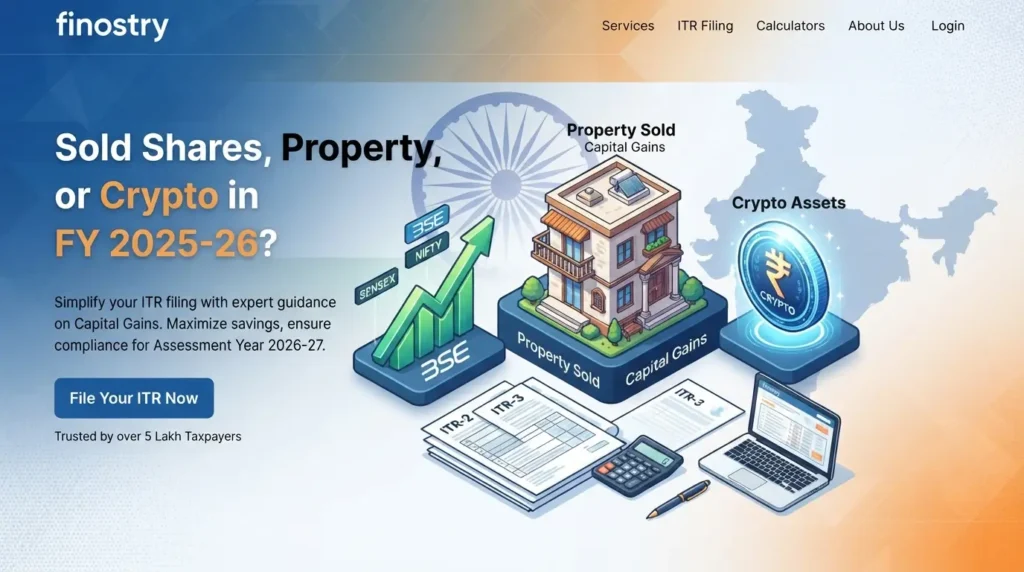
Post-pandemic, a lot more Indians are dabbling in equities, ESOPs, RSUs, crypto, and even foreign stocks. Naturally, the Income Tax Department has started paying much closer attention to capital gains. As FY 2025-26 filings roll in, the department is cross-checking everything against your AIS, Form 26AS, broker statements, mutual fund records, and even data shared by foreign tax authorities.
Where Most People Go Wrong
Here’s the thing — most tax notices don’t happen because someone’s trying to dodge taxes. They happen because of honest, avoidable mistakes. The usual suspects:
- Forgetting transactions spread across multiple brokers or apps.
- Getting the holding period wrong and mislabeling gains as short-term when they’re long-term (or vice versa).
- Copy-pasting numbers straight from a brokerage statement instead of reconciling with AIS.
- Skipping gains from foreign shares, global ETFs, or overseas platforms entirely.
- Reporting crypto profits as one lump sum instead of transaction by transaction.
- Missing the window to claim exemptions under Sections 54, 54F, or 54EC.
- Not disclosing foreign assets when it’s actually required.
- Filing late and losing the right to carry forward capital losses.
None of these are hard to fix — they just need a bit of attention before you hit submit.
Start by Figuring Out What You Actually Sold
Before you calculate anything, pin down exactly what kind of asset you sold. That single step shapes everything that follows.
In general, your capital gain is what’s left after you subtract:
- What you originally paid for the asset
- Any money spent improving it (where relevant)
- Costs tied to the sale itself
- Any exemptions you’re eligible for
Sounds straightforward, right? It usually is — until you get the classification wrong, and then your tax bill can jump for no good reason.
Short-Term or Long-Term? This One Decision Changes Everything
Here’s a scenario: two people sell the same listed stock in the same financial year. One held it for eight months, the other for fourteen. That gap alone means they could be taxed completely differently.
Why does this matter so much? Because the holding period decides:
- Which tax rate applies?
- Which exemptions can you claim?
- How can losses be set off?
- What do you actually need to report?
And the “correct” holding period isn’t the same across asset types — so don’t assume the rule that applies to your shares also applies to your property or your debt fund.
Shares and Mutual Funds Aren’t Taxed the Same Way
It’s easy to lump shares and mutual funds together in your head, but tax-wise, they don’t always play by the same rules.
Listed equity shares and equity mutual funds are treated fairly similarly — you get an annual exemption of ₹1.25 lakh on long-term gains before any tax kicks in.
But step outside that category — debt funds, international funds, gold funds, fund-of-funds, certain hybrid schemes — and the rules change. For instance, debt mutual funds bought on or after April 1, 2023 generally don’t get long-term capital gains treatment at all; they’re taxed at your regular income slab rate instead.
Moral of the story: check what kind of fund you’re dealing with before you assume how it’s taxed.
Grandfathering and the Indexation Rollback — What Changed
Tax rules around capital gains have shifted quite a bit over the past few years, and it trips up even seasoned investors.
One concept worth knowing is grandfathering — essentially, a safeguard that protects gains you earned before a rule change came into effect. When the long-term capital gains tax on listed equities came back into force from April 1, 2018, any gains built up until January 31, 2018 were shielded under this provision.
The other big shift: indexation benefits have been withdrawn for several long-term assets. Previously, you could adjust your purchase price for inflation and pay tax only on the “real” gain. Now, many long-term gains are taxed at a flat 12.5% rate, with no indexation.
That lower rate might look appealing at first glance, but if you’ve held an asset for a long time, losing the inflation adjustment could actually push your taxable gain higher than expected.
Selling a House? You Get to Pick Your Tax Route
If you sold a residential property in FY 2025-26, you actually have a choice:
- Pay 12.5% tax without indexation, or
- Pay 20% tax with indexation.
Which one works out cheaper depends on when you bought the property, how much inflation has eaten into its value, your sale price, and how long you held it. It’s worth running both calculations before you decide — the difference can be significant.
Foreign Shares, ESOPs, and RSUs Deserve Extra Care
More and more Indian professionals are getting ESOPs or RSUs from global employers, or investing directly in US stocks, foreign ETFs, and overseas mutual funds. These come with their own compliance baggage since they’re not treated the same as Indian listed shares.
For unlisted shares specifically:
- Short-term gains are taxed at your regular slab rate.
- Long-term gains are taxed at 12.5%, without indexation.
And if you’re dealing with foreign investments, you’ll also want to:
- Hold onto your broker statements.
- Track any foreign tax you’ve already paid.
- Keep your currency conversion workings handy.
- Check if you qualify for the Foreign Tax Credit.
- Disclose foreign assets in your ITR if applicable.
With countries sharing more financial data with each other than ever before, this isn’t an area to be casual about.
ESOPs and RSUs Are Taxed Twice — Not Once
This one catches a lot of people off guard. ESOPs and RSUs trigger two separate tax events, not one.
The first happens when your shares are allotted or exercised — that value gets taxed as a salary perquisite. The second happens later, when you actually sell those shares, and that’s when capital gains tax kicks in.
For calculating your holding period, the clock generally starts from the allotment date, and if the shares belong to a foreign company, you may also need to disclose them under Schedule Foreign Assets.
Crypto: The Most Misunderstood Tax Area Right Now
A lot of crypto investors just report their total profit for the year and call it done. That’s not how the rules work — every transaction needs to be reported individually.
Here’s what currently applies:
- A flat 30% tax on gains.
- Only your original purchase cost can be deducted — nothing else.
- Losses can’t be offset against other income, and they can’t be carried forward.
- If you received crypto as a gift, it might be taxable in your hands.
- All transactions need to go into Schedule VDA separately.
- A 1% TDS may apply to certain transactions.
This includes crypto-to-crypto swaps and trades made on foreign exchanges — yes, those count too. Skipping any of this can easily create mismatches with your AIS or Form 26AS.
Is It Really “Capital Gains,” Though?
Not every rupee you make from the markets counts as a capital gain.
- Intraday trading profits are usually treated as business income.
- F&O gains or losses generally fall under non-speculative business income
This distinction isn’t just semantics — it changes how your tax is calculated, how losses can be adjusted, what expenses you can claim, and how you report it in your ITR. Getting the income head wrong can throw off your entire filing.
Exemptions Worth Remembering
A few provisions can meaningfully reduce your capital gains tax bill if you use them correctly:
Section 54 — kicks in when you reinvest long-term gains from a residential property into another residential property in India.
Section 54F — applies when you invest proceeds from other long-term assets (not property) into a residential house.
Section 54EC — lets you claim exemption by investing eligible gains into specific bonds, like NHAI or REC bonds, within six months, up to a set limit.
A surprising number of people miss out on these simply because they miss a deadline or don’t keep the right paperwork.
Don’t Overlook Your Capital Losses
Capital losses aren’t just bad news — they can actually work in your favor come tax time.
- Short-term losses can offset both short-term and long-term gains.
- Long-term losses can only be set off against long-term gains.
You can generally carry forward unused losses for up to eight assessment years — but only if you file your return on time. File late, and that benefit disappears.
What About Inherited or Gifted Property?
Good news first: inheriting or receiving a gifted asset doesn’t trigger capital gains tax by itself.
The catch comes later — when you sell that asset, capital gains tax does apply. And to calculate it correctly, you’ll need to know the original owner’s purchase cost and their holding period, not just your own.
This is exactly why keeping old purchase records — even for assets you didn’t originally buy — can save you a headache down the line.
The Bottom Line
Capital gains reporting isn’t the “extra” part of filing your ITR anymore — it’s central to it. Between AIS, Form 26AS, broker data, mutual fund disclosures, and cross-border information sharing, tax authorities have far more visibility into your transactions than they used to.
Before you file, take a moment to:
- Pull together all your transaction records.
- Double-check the holding period for every asset you sold.
- Reconcile your numbers with AIS and Form 26AS.
- See if you qualify for any exemptions.
- Keep your foreign investment paperwork in order.
A few extra hours spent getting this right now can save you from notices, delayed refunds, and unwanted tax demands later.
(Disclaimer: The above article is intended for informational purposes solely and should not be construed as investment advice. FINOSTRY advises its readers/audience to consult with their financial advisors before making any decisions related to money matters.)

Loves to write about personal finance, credit cards rewards, banking, mutual funds, fixed deposits, savings strategies, investment planning, tax-saving options, digital banking and wealth building techniques. With over 12 years of experience he aims to provide practical financial knowledge that is easy to understand for both beginners and experienced readers.
Related posts:
 Simplify Your ITR Process: Discover the New AIS Feature for ITR Filing FY24
 Comparing New Tax Regime with Old Tax Regime: Which Reigns Supreme? Explore Vital Contrasts in Income Tax Slabs, Rates, Deductions, and More
 3 Reasons You’ll Have More Money in Hand from April 1: New Financial Year 2025-26
 Tata Stock Between Rs 200! Dividend Yield 2.20%: LIC owns 7.3% stake; When to BUY?
 Stock Return: Green Energy Share Generates 10,000% Growth: Turning Rs 1 Lakh into Rs 1 Crore in Just 3 Years! Is it a Buy?
 Investing in Tata stocks in 2024: Grab 6 shares for promising returns – Complete selection.
 Top Performing Large Cap Mutual Funds in India Throughout the Last Decade. Do you have any of these in your portfolio?
 AU Bank Credit Card- Apply for Lifetime Free
 Large Cap Fund: Understanding the Basic
 Amazon Pay ICICI Credit Card Lifetime Free Card
 Best Rupay Credit Card: Top 10 Rupay Credit Cards
 HDFC Credit Card Status: 4 ways to Check
 Suryoday Small Finance Bank Launches FD-Backed UPI Credit Cards- Apply now
 Devaluation of Amazon Pay ICICI Credit Card: No longer the Preferred Card?
 Airtel Axis Credit Card Devalued- Starting from April 2026, Cashback structure has been changed, lounge access will no longer be available.